
Data science
Preserving probability in data augmentation
Distribution integrity when scaling and augmenting data.
Original titleObtaining exact probability distribution integrity in data scaling and augmentation
In this article7 sections
On quantum computing, African health data, and why the hardest problem in synthetic data might finally have an answer.
Kossiso Royce Udodi
There’s a problem in machine learning that almost nobody talks about honestly. When you train a model on a dataset from a population that’s underrepresented in global research, say, maternal health outcomes in northern Nigeria, or smallholder crop failures in the Sahel, you’re not just dealing with less data. You’re dealing with data whose internal structure is fundamentally harder to model.
The correlations are different. The rare events are rarer. The feature relationships don’t follow the distributions that classical synthetic data tools were built to approximate. And so when you try to augment your dataset — to generate synthetic records that could fill the gaps — you get something that looks right on the surface but is wrong underneath. The synthetic data has the right marginal distributions. The joints are off.
We’ve been working with this quietly for years. We have gotten good at measuring the wrongness — KS distance, MMD scores, that kind of thing — but not at fixing it. The tools we have are approximations. Good approximations, sometimes. But approximations still.
I. Why this is a hard problem
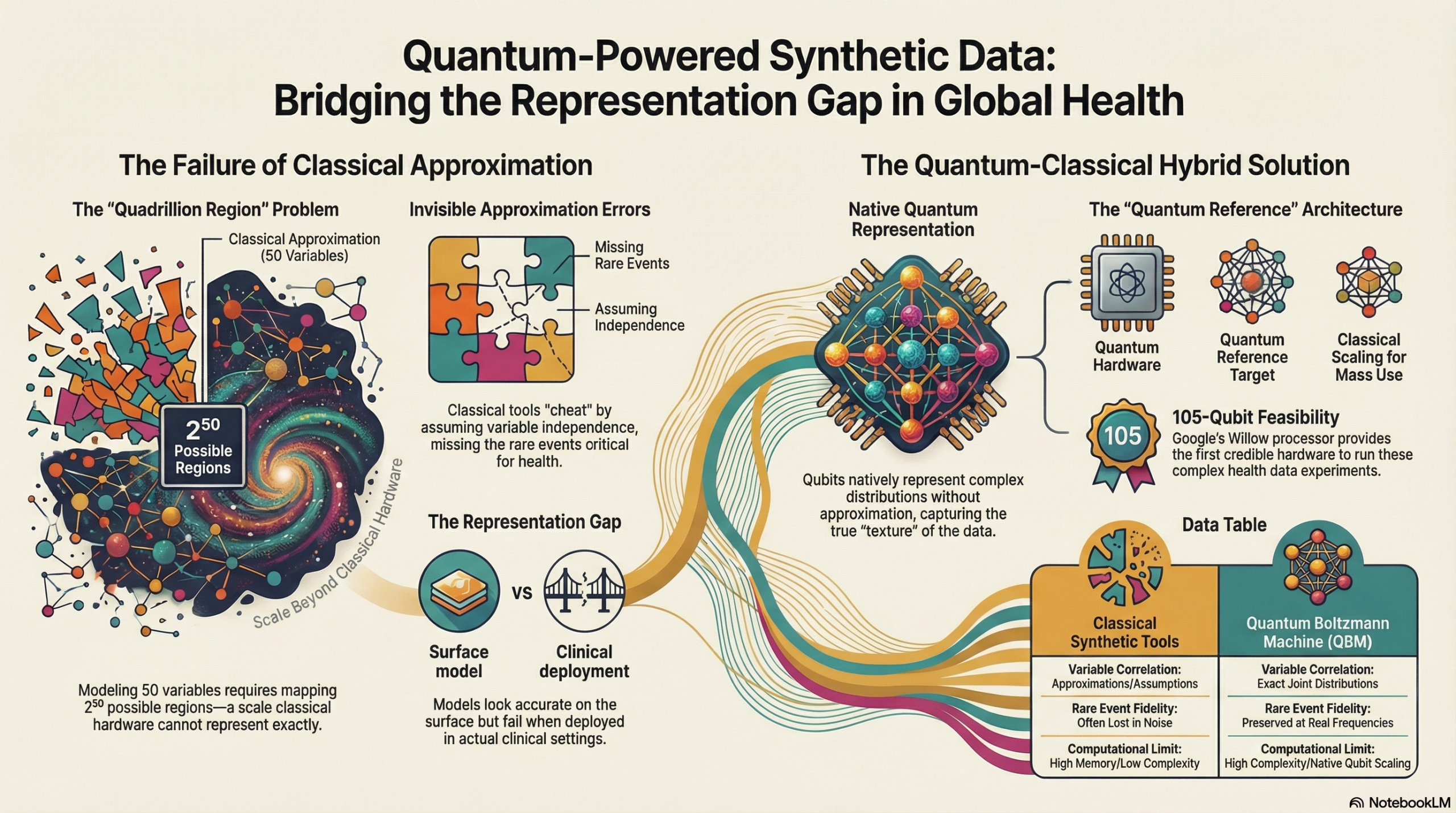
To understand why, you need to think about what a joint probability distribution actually is. If you have a dataset with fifty variables, the true distribution over all of them is a function over a space with 2⁵⁰ possible regions. That’s roughly a quadrillion. Classical computers represent this by cheating. They assume some variables are independent when they aren’t, or they fit parametric families that capture the shape but miss the texture.
This is fine for lots of problems. If you’re generating synthetic data for a well-studied population with plenty of records, the approximation errors are small relative to the signal. But for rare-event distributions in data-sparse populations, the approximation errors are the whole game. The rare events live precisely in the regions of the distribution that classical methods get wrong. The gap between a good approximation and the true distribution is usually invisible. Until you train a model on it, deploy it in a clinic, and it fails on the exact cases you most needed it to catch.
For a long time, this felt like a fundamental limitation. Not a tooling problem. A mathematical one. You can’t represent a 2⁵⁰-dimensional distribution exactly on classical hardware without astronomical memory. So you approximate. And you live with the consequences.
II. What quantum computing changes
Here’s the thing about quantum states that most explanations bury. A system of n qubits doesn’t just represent n bits of information. It natively represents a probability distribution over 2ⁿ possible states — exactly, not approximately — encoded in the amplitudes of the quantum state. This is just what a quantum state is.
Which means a Quantum Boltzmann Machine running on a fifty-qubit system can represent the joint distribution over fifty variables without any of the classical approximations. When you sample from it, you’re drawing from the true joint, not a model of the true joint. The correlations are preserved. The rare events appear at their real frequencies.
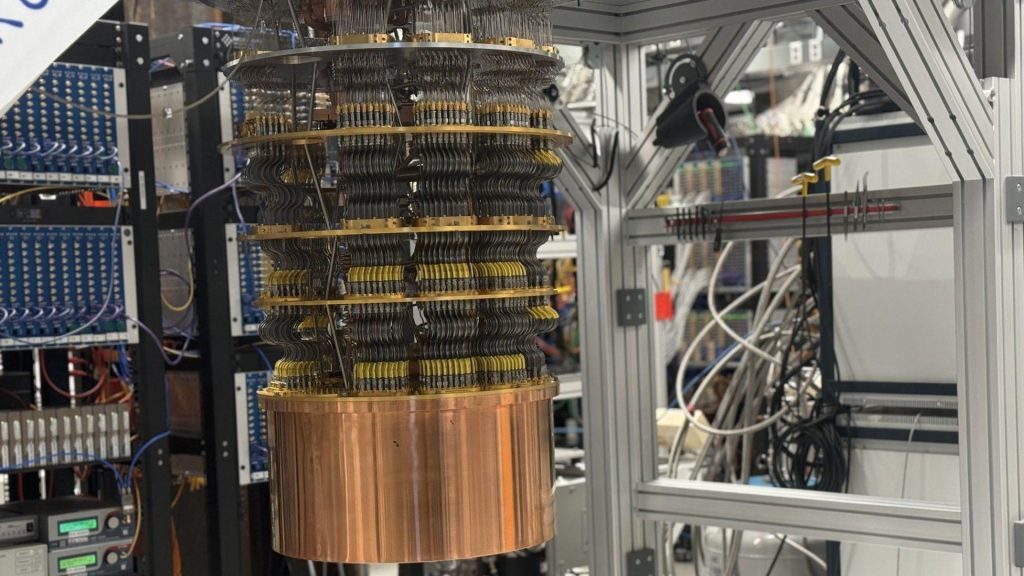
Google’s Willow processor — 105 qubits, below-threshold error correction — is the first hardware where this is credibly runnable. Not at full scale. Not for a thousand-variable dataset. But for a carefully prepared twenty to fifty variable encoding of a real African health dataset, the experiment is feasible now.
We hope to run it.
III. What we’re actually proposing
The experiment is this. Take a maternal health dataset from Electric Sheep Africa’s repository — one of the highest-quality structured health datasets collected specifically for sub-Saharan African populations. Apply PCA to reduce it to a twenty-to-thirty feature representation that captures the dominant variance while fitting within Willow’s qubit budget. Train a Quantum Boltzmann Machine on this reduced representation. Sample synthetic records from the trained QBM. Then validate those records against known epidemiological priors — published prevalence rates for the conditions in question, from WHO and peer-reviewed sources.
The observable output is clean. Do the quantum-sampled records match known prevalence rates better than classically-generated synthetic data from the same seed dataset? That’s a measurable question with a publishable answer regardless of which direction things go.
If the answer is yes, and we believe it will be, the implications go further than the paper.
IV. The insight
The valuable thing isn’t running circuits on Willow. The valuable thing is what we do with the output.
A QBM sampling run on Willow produces a reference distribution — a high-fidelity characterization of the true joint distribution for that dataset domain, derived from quantum sampling rather than classical approximation. You can’t generate a million records from Willow directly. But you can train a classical generative model — a normalizing flow, a diffusion model, anything — to match that quantum reference. And from that calibrated classical model, you can generate at whatever scale you need, cheaply, indefinitely.
The quantum run happens once per domain. It produces a certified target. The classical model chases that target at scale. This is the architecture: quantum sets the distribution, classical delivers the volume.
What this produces, if it works, is a new quality standard for synthetic data. Not measured by classical statistical tests — which are themselves approximations — but by fidelity to a quantum-sampled reference that classical methods can’t fully replicate.
For African health, agriculture, and financial datasets specifically, this matters in a way it doesn’t for well-studied populations. The data scarcity problem in African ML isn’t just about quantity. It’s about the quality of augmentation. Better synthetic data means better models. Better models deployed at the edge — compiled to lean inference artifacts, running on devices in low-resource clinical settings without cloud dependency — means better outcomes for the populations the data actually describes.
V. What we genuinely don’t know yet
I want to be honest about the uncertainty here, because I think overclaiming is how promising research becomes discredited research.
We don’t yet know whether a QBM trained on twenty-to-thirty features of a maternal health dataset will produce measurably better synthetic data than a classical method on the same inputs. It’s theoretically well-motivated. The quantum advantage for representing joint distributions is real. But real hardware has noise, and the gap between theory and a 105-qubit device with 0.14% error per cycle is not trivial.
We also don’t know whether the dimensionality reduction required to fit within Willow’s qubit budget will preserve enough of the original distribution’s structure for the quantum advantage to survive. PCA throws away variance. How much variance you can afford to throw away before the rare-event structure is lost is an empirical question we’ll answer in the simulation phase.
And we don’t know how the quantum-classical calibration step — training a classical model to match the quantum reference — will behave in practice. In principle, a good normalizing flow can learn to approximate any distribution. In practice, if the quantum reference is only marginally better than a classical baseline, the classical model may not capture the improvement faithfully enough to matter downstream.
These are honest unknowns. They’re why the experiment is worth running.
VI. Why now, why here
Synthetic data quality is ultimately a question of whose data gets quality treatment. The infrastructure for generating high-fidelity synthetic records — the benchmark datasets, the validation frameworks, the trained generative models — has been built almost entirely on Western medical and financial data. Not because the people building it are indifferent to other populations. Because they work with what’s in front of them.
This creates a compounding problem. Models trained on low-fidelity synthetic data from underrepresented populations perform worse. Worse performance means less investment in better data for those populations. The gap widens quietly, not through anyone’s decision, just through the accumulated weight of where resources and attention flow naturally.
Quantum-assisted sampling doesn’t fix this by itself. But it does something specific that matters here: it makes the quality of synthetic data a function of the seed dataset’s structure, not of how many classical generative modeling papers have been written about that population. A QBM doesn’t know or care that northern Nigerian maternal health data is underrepresented in NeurIPS proceedings. It samples from the distribution it’s trained on with the same fidelity it would apply to any other.
Seed data exists. Deployment endpoints exist. The gap is in the middle — the quality of what gets generated between collection and deployment.